The End of Browsing: Why AI Will Redefine Retail Leadership
The Future of Retail is a thought leadership series from Cherson Advisory exploring the strategic forces reshaping retail, health and wellness.
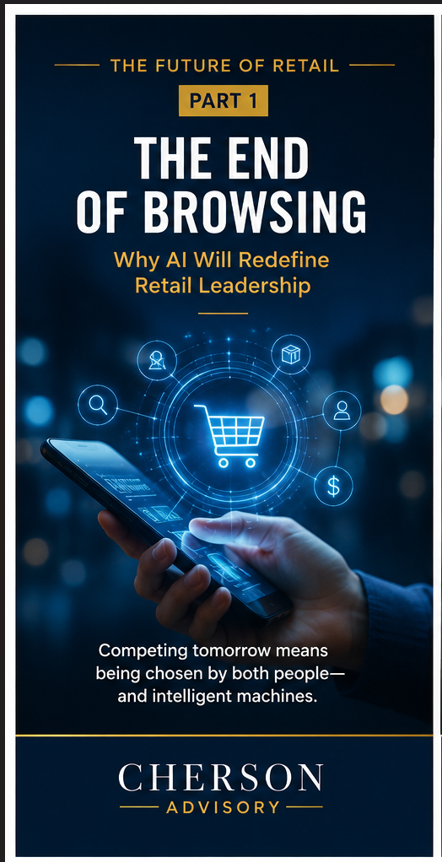
For more than three decades, retail has been shaped by one fundamental assumption: customers make purchasing decisions.
They browse websites, compare prices, visit stores, read reviews, respond to promotions and ultimately choose where to spend their money. Entire retail strategies have been built around influencing that journey. Marketing teams optimise search rankings. Merchandising teams refine assortments. Store networks are designed to maximise convenience. Loyalty programs seek to encourage repeat visits.
That assumption is now beginning to fracture.
For the first time in modern retail history, consumers are increasingly delegating parts of the purchasing process to artificial intelligence. AI is no longer simply helping retailers operate more efficiently; it is becoming an active participant in how buying decisions are made. The emergence of AI-powered shopping assistants and autonomous purchasing agents represents far more than another digital innovation. It challenges the very foundations upon which retail strategy has been built.
The question facing retailers is no longer whether AI will influence commerce. It is whether retailers will remain visible when AI becomes the primary decision-maker.
For decades, retailers have competed for one thing: Customer attention.
The best location.
The best website.
The best advertising.
The highest Google ranking.
But what happens when customers stop searching?
Increasingly, consumers are asking AI to compare products, evaluate brands, recommend the best option and, in many cases, make the purchase on their behalf. That changes the rules of competition. Retailers have spent years optimising for search engines. Tomorrow, they may need to optimise for AI recommendation engines.
The strategic question for every business leader is no longer "How do we drive more traffic?"
It is: "How do we become the brand AI chooses to recommend?"
This isn't simply another technology trend. It is a fundamental shift in consumer behaviour.
It also raises important governance questions.
• How will AI reshape customer acquisition?
• What happens if consumers never visit our website?
• Will brand equity become more or less important?
• How should organisations invest in trusted data and digital capability?
• What new risks emerge when algorithms influence purchasing decisions?
Ironically, the rise of AI makes human qualities even more valuable.
Trust.
Purpose.
Empathy.
Professional advice.
Community.
Technology will become increasingly capable of managing transactions. It cannot replace genuine relationships. The retailers that thrive over the next decade will combine intelligent technology with experiences that customers genuinely value.
The organisations that prosper will not necessarily be those with the largest technology budgets. They will be those whose leaders recognise that AI is fundamentally changing how decisions are made—not simply how transactions occur.
This demands curiosity, strategic foresight and the willingness to rethink assumptions that have guided retail for decades. The future of retail will not be determined solely by who has the best products, the biggest stores or the most sophisticated digital platform.
Perhaps the future of retail won't be decided by who has the best products.
It may be decided by who earns the confidence of both people—and intelligent machines.
That is a different competitive landscape.
And it has already begun.
Jeff Sher is the founder of Cherson Advisory, advising boards, investors and executive teams on strategy, transformation, governance and operational excellence across the health, wellness and consumer sectors. Cherson Advisory works with organisations seeking to build resilient businesses capable of adapting to profound shifts in markets, technology and consumer behaviour.

Comments