The Future of Retail | Part 2: The Death of Customer Loyalty
Why Trust, Not Points, Will Become Retail's Greatest Competitive Advantage
There was a time when customer loyalty appeared remarkably straightforward.
Retailers introduced loyalty cards. Customers accumulated points. Discounts encouraged repeat purchases. Redemption rates became a key performance indicator and membership growth was celebrated in annual reports. Success was often measured by one deceptively simple number: How many loyalty members do we have?
Today, that question feels increasingly inadequate.
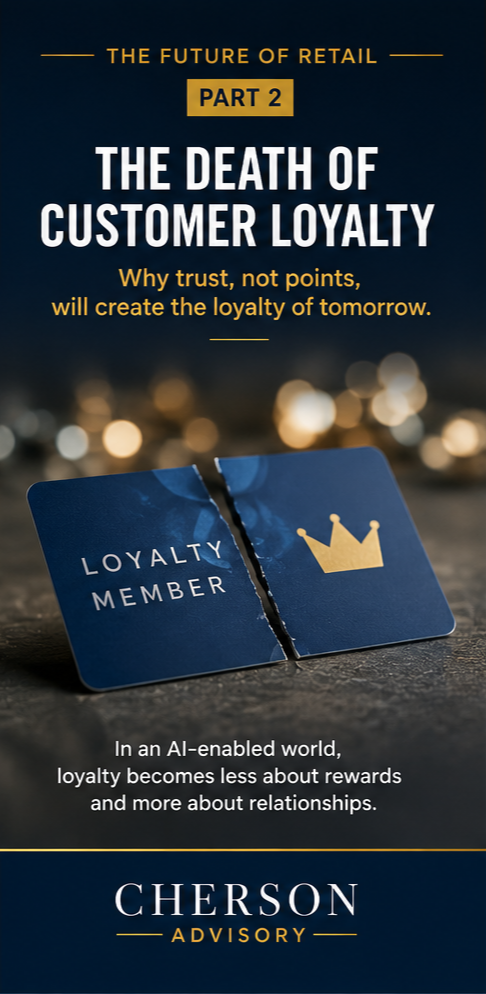
The average consumer belongs to multiple loyalty programs—sometimes well into double figures—yet actively engages with only a small proportion of them. Membership has become commonplace. Genuine loyalty has not. Somewhere over the past decade, loyalty quietly evolved from a strategic asset into a marketing mechanism.
The distinction matters.
Membership Is Not Loyalty
Many retailers proudly announce millions of loyalty members. Yet those same customers routinely compare prices across multiple retailers, search for promotional offers before purchasing and switch brands with little hesitation. That isn't necessarily disloyal behaviour. It is rational behaviour.
Digital commerce has dramatically reduced the cost of switching. - Price comparison takes seconds. - Reviews are instantly available. - Delivery times are transparent. - Returns are easier than ever.
Consumers have become highly informed, and increasingly, highly efficient.
The traditional barriers that once encouraged loyalty have largely disappeared.
What remains is trust.
Artificial Intelligence Changes the Equation
The arrival of generative AI and intelligent shopping assistants represents the next significant shift. Consumers are beginning to delegate product research, price comparisons and purchasing decisions to AI-powered tools. Instead of manually comparing ten retailers, an AI assistant may evaluate hundreds of variables within seconds. The implications for retailers are profound.
Historically, organisations competed for customer attention. Increasingly, they will compete for algorithmic recommendation. If AI can instantly identify the lowest price or fastest delivery, traditional loyalty programs become significantly less influential.
When every retailer is equally visible, the differentiator is unlikely to be another discount.
It will be confidence.
Trust Is Becoming Retail's New Currency
The 2025 Edelman Trust Barometer concluded that trust has become as important as price and quality in consumers' purchasing decisions. More significantly, the research found that consumers increasingly expect brands to provide confidence, stability and genuine value—not simply products. This represents an important evolution in retail strategy. Trust is no longer simply an outcome of good business. It has become a competitive capability.
Consumers increasingly ask themselves questions that transcend price.
Can I rely on this brand?
Will they resolve problems fairly?
Do they consistently deliver what they promise?
Do they understand me?
Would I confidently recommend them to someone else?
These are questions no points program can answer.
Fred Reichheld Was Right—Perhaps More Than Ever
More than two decades ago, loyalty pioneer Fred Reichheld challenged organisations to rethink what loyalty actually meant. His work on loyalty economics shifted attention away from transactions towards advocacy.
Nearly three decades ago, Fred Reichheld transformed executive thinking by arguing that customer loyalty was not merely a marketing outcome but an economic asset capable of driving long-term profitability. His work on 'loyalty economics' shifted the conversation from transactions to relationships—a perspective that remains remarkably relevant today.
That observation feels even more significant in an AI-enabled economy. Recommendation has always mattered. Now recommendation increasingly occurs twice.
First by customers. Then by intelligent machines.
Yet the next evolution of loyalty extends beyond customer recommendation. Increasingly, organisations must earn the confidence of both customers and the intelligent systems that increasingly shape purchasing decisions. My sense is that loyalty is evolving through three distinct eras:
Transactional Loyalty (points, discounts, incentives)
Relational Loyalty (trust, consistency, experience)
Algorithmic Loyalty (AI increasingly influencing who gets recommended)
Loyalty Is Becoming an Outcome, Not a Program
Perhaps the greatest misconception in modern retail is believing loyalty can be designed through incentives alone. Discounts may increase purchase frequency. Points may encourage repeat visits. Promotions may temporarily influence behaviour. But none of these necessarily create attachment. True loyalty is an outcome of consistently delivering value. It emerges when customers believe an organisation understands them, respects them and reliably acts in their best interests. Artificial intelligence may even accelerate this distinction.
As algorithms become increasingly effective at comparing price and functionality, the emotional dimensions of retail become more—not less—important.
Trust.
Empathy.
Authenticity.
Purpose.
Human expertise.
These attributes cannot easily be commoditised.
Beyond Transactions
There is a broader lesson emerging for retail leaders. Technology is steadily reducing the value of information asymmetry. Consumers—and increasingly AI—can compare products, prices and reviews with extraordinary speed. Competitive advantage will therefore rely less on what retailers sell and more on how consistently they are trusted.
Loyalty has never really been about points. It has always been about confidence.
The organisations that prosper over the coming decade will understand that loyalty is not created through rewards alone. It is earned through competence, consistency, transparency and genuine human connection. Because in a world where technology makes every retailer accessible, trust becomes the only advantage that competitors cannot easily replicate.
Jeff Sher is the Founder of Cherson Advisory, advising boards, executive teams and investors on strategy, governance, transformation and operational excellence across the retail, pharmacy, health and wellness sectors.
The Future of Retail is an ongoing thought leadership series exploring the strategic forces reshaping retail over the next decade.

Comments